beamjockey: Drawing of Bill of the Heterodyne Boys by Phil Foglio. (Default)
I just realized that, although I use a Windows machine every business day, I never touch the function keys. I mean the ones labeled F1 through F12, above the number row on the QWERTY part of the keyboard.

I don't even know what the F#-keys do, though I am perfectly capable of finding out.

To me, the most significance they have is that the number keys and the F#-keys form a nice little trough I keep a pencil in.

In the past, I have been a power user on Macs and on VT220 keyboards. Just never bothered, I guess, to figure out the possibilities on a Windows keyboard.

What's your favorite F# key?
beamjockey: Drawing of Bill of the Heterodyne Boys by Phil Foglio. (Default)
In addition to his work on pure mathematics, John von Neumann contributed fundamental advances to dozens of fields, from quantum mechanics to weather prediction. In particular, he was a pivotal figure in the development of electronic digital computers.

I've been reading George Dyson's terrific book Turing's Cathedral: The Origins of the Digital Universe. Within its pages, I found an interesting quote. Von Neumann's father Max was a Budapest banker who discussed his work with his children at the dinner table. Dyson quotes Nicholas A. Vonneuman* in John von Neumann As Seen by His Brother. Dyson writes:
Max believed in demonstrating practical examples of the industrial applications of finance. "If these activities involved financing of a newspaper enterprise, the discussion was about the printing press and he brought home and demonstrated samples of type,” says Nicholas. “Or if it was a textile enterprise, e.g., the 'Hungaria Jacquard Textile Weaving Factory,' the discussion centered around the Jacquard automatic loom. It probably does not take much imagination to trace this experience to John's later interest in punched cards!"
This offers a connection between Jacquard's loom and an individual deeply involved in developing the stored-program architecture now featured in virtually all computers. I should add this quote to my "Babbage's Favorite Picture" talk.**


* Different members of the family Anglicized their Hungarian names into different spellings.

**It took me fifteen years before I managed to find an image of the Jacquard Jacquard, but I now see that it pops up on Wikipedia for all to see in seconds.
beamjockey: Drawing of Bill of the Heterodyne Boys by Phil Foglio. (Default)
Hugh Daniel has passed away. He was a good friend for more than three decades.

I have spoken to a member of his family; they haven't yet made funeral plans.

Hugh was known among hackers, among science fiction fans, among privacy advocates, and, no doubt, among people in many more circles beyond I'm not aware of. He was a walking bundle of enthusiasm. This morning, Eric S. Raymond wrote, "World will be a duller place with Hugh gone." Amen to that.

Here's my 2011 essay about Hugh.
beamjockey: Drawing of Bill of the Heterodyne Boys by Phil Foglio. (Default)
Recently I contributed to a discussion on the Restricted Data blog, and decided I should expand upon it here.

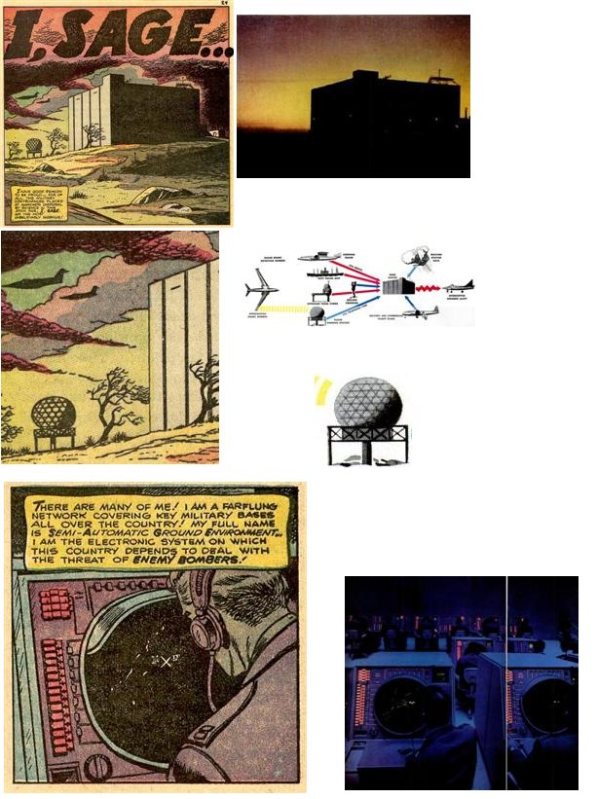
Wikipedia tells us, "Swipe is a comics term that refers to the intentional copying of a cover, panel, or page from an earlier comic book or graphic novel without crediting the original artist."

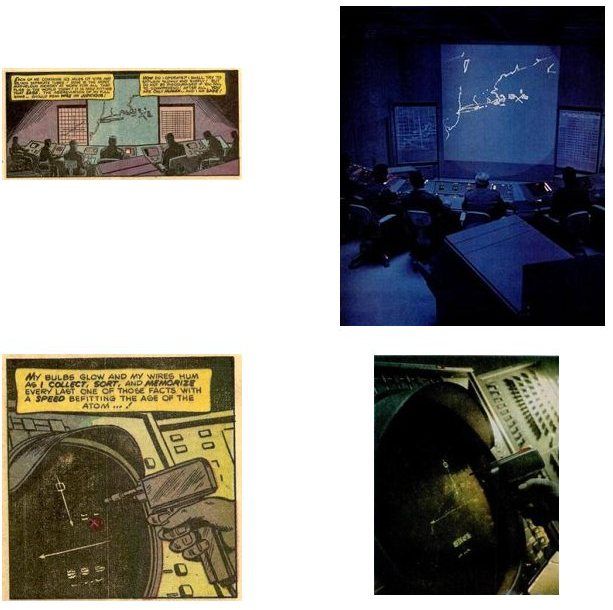
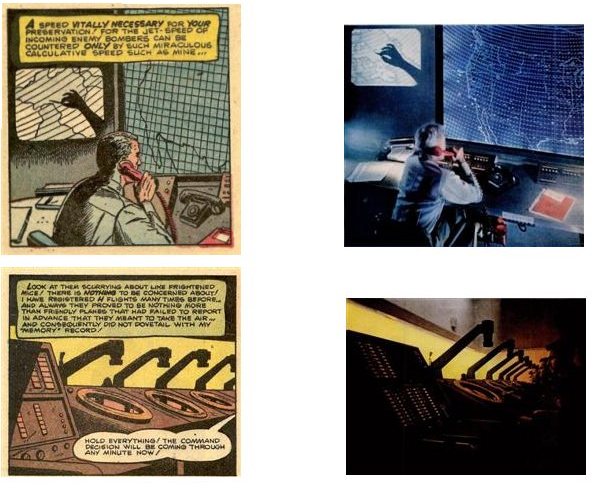
Photographs can be "swiped," too. And we may expect that, in the heyday of Henry Luce's illustrated magazine Life, its superb photos and graphics might commonly have been found in any comics artist’s reference files. Let me show you an interesting example.

In Issue 1 of the 1958 revival of the war comic book Atom Age Combat, we find a feature entitled “I, SAGE…” The Semi-Automatic Ground Environment, robot sentry of the Cold War skies, narrates. It’s pretty effective non-fiction.

(SAGE is interesting to students of computer science as an early example of a complex system using computers to process real-time information. Some SAGE consoles are preserved at such places as the Computer History Museum.)

Question: How many of Andreas Feininger's photos in Life‘s six-page spread in the February 11, 1957 issue, namely “Pushbutton Defense for Air War,” have been swiped by the artist drawing “I, SAGE…?”

Answer: All of them, save one.

The uncredited artist even lifts some elements, like a radar dome, from the Life diagram of SAGE prepared by Matt Greene and Jerry Cooke.

One wonders how many of the other panels in the story were also swipes from sources we have not detected.

It seem strange that the artist did not swipe J.R. Eyerman's spectacular photo of an F-102 Delta Dagger unleashing fiery missiles-- one can imagine a young George W. Bush at the controls-- given that the SAGE story includes several panels of F-102s in combat. In addition, there is a single-page profile of the F-102 later in the book.

beamjockey: Drawing of Bill of the Heterodyne Boys by Phil Foglio. (Default)
I'll be at Capricon 33 in Wheeling, Illinois this weekend, having attended thirty-two Capricons previously.

Science Reporting Sucks Rocks
Friday, 02-08-2013
11:30 am to 1:00 pm
Botanic Garden A

Correlation is not causation! Every day, the news butchers articles about health, climate change, and technological advancements. Science literacy continues to suffer in the US. Why does this happen? How can we prevent it?

Dr. Lisa Freitag
Bill Higgins (Moderator)
W. A. (Bill) Thomasson
Dr. Michael Unger

Nerdvana: Big Bang Theory's Impact on the Perception of Fandom
Friday, 02-08-2013
1:00 pm to 2:30 pm
Birch A

Love it or leave it, everyone seems to be watching the Big Bang Theory. The shows fan community reaches beyond whom we would expect to be interested. Are they laughing at us or with us?

Jerry Gilio (Moderator)
Liz Gilio
Bill Higgins
Mary Anne Mohanraj

Curiosity on Mars Slideshow
Friday, 02-08-2013
4:00 pm to 5:30 pm
River AB
Curiosity is on Mars and there's more out there than Marvin the Martian. Come feed your curiosity with the latest from Curiosity.

Bill Higgins

Higgins and Silver Talk
[This really could have used a better title...]
Friday, 02-08-2013
7:00 pm to 8:30 pm
Bill Higgins and Steven Silver discovered a joint affection for Brewer's Dictionary of Phrase and Fable, a collection explaining the background of common sayings. In this wide-ranging discussion, the two use randomly selected entries to guide their conversation.

Bill Higgins
Steven H Silver

AI Vision: Early AI vs. Current Technology
Saturday, 02-09-2013
1:00 pm to 2:30 pm
Botanic Garden A
Humankind has been dreaming of thinking machines for centuries. History, philosophy, mechanics, computing, and human imagination feed this dream. What has been and what will be?

Peter de Jong
James Dobbs (Moderator)
Bill Higgins

Riverworlds: The Latest on Mars and Titan
Saturday, 02-09-2013
4:00 pm to 5:30 pm
Botanic Garden A

Dried river beds on Mars? A mini Nile on Titan? Interesting. We want to learn more.

Bill Higgins
Jeffrey Liss
Jim Plaxco (Moderator)
beamjockey: Drawing of Bill of the Heterodyne Boys by Phil Foglio. (Default)
As someone whose workplace is concerned with inverse femtobarns, I am somewhat aware of the importance of standard prefixes for very small or very large numbers.

In the article about puppies killing the Internet, the reference to a "zettabyte" got me thinking about prefixes we use for big binary numbers like kilobytes and megabytes. Turns out the International Electrotechnical Commission has tried to set some standards for this sort of thing.

The IEC explains the problem:
As time has passed, kilobytes have grown into megabytes and megabytes into gigabytes. Within a few years, ordinary PC or laptop data storage could well be measured in terabytes and very large industrial or scientific systems in peta- or even exabytes. The problem is that, even at the SI tera-scale (1012), the discrepancy with the binary equivalent (240) is not the 2,4 % at kilo-scale but rather approaching 10 %. At exa-scale (1018 and 260), it is nearer 20 %. The niceties of mathematics dictate that the bigger the number of bytes, the bigger the differential, so the inaccuracies – for engineers, marketing staff and public alike – are set to grow more and more significant. This is one good reason for the IEC to have standardized prefixes for binary multiples.

The other primary reason is that different parts of the IT industry had started to confuse themselves. In the computing world, for example, the major disk-drive manufacturers tend to mean what they say in kilobytes, megabytes, gigabytes and so on of storage, i.e. precisely 1 000 B, 1 000 000 B and 1 000 000 000 B respectively, according to the decimal prefix. Memory, on the other hand, is described using the decimal prefix but actually supplied in binary quantities, so 512 MB of RAM bought on the high street generally means 536 870 912 B and, as shown in the table, should more properly be described as 512 MiB (mebibytes) or 537 MB.

I made a chart to illustrate the difference between 210N and 103N running up to a decigoogol (1099). I normalized the difference two different ways:
Binary: (210N - 103N)/(210N)
Decimal: (210N - 103N)/(103N)

Chart behind cut )The difference is a few percent in the kiloscale to gigascale range, but it hits 20% around 2100 and becomes a positively embarrassing 50% around 2300--a number which is more than twice the size of 1090.

The IEC's solution is to offer a family of alternative prefixes which express powers of 2 precisely.

I don't think I am likely to stop saying "terabyte" and start saying "tebibyte" anytime soon, but it's nice to know that the distinction exists, and that I can adopt it if I have a need to express these numbers more precisely.

Moore's Law does suggest that we are headed for an era when the distinction will really matter in specifications and advertising of computer hardware. Mark my words, we will live to see the Exbibyte Wars.


Prefixes
for binary multiples


 Factor  Name  Symbol  Origin Derivation 
 210 kibi Ki kilobinary: (210)1 kilo: (103)1
 220 mebi Mi megabinary: (210) mega: (103)2
 230 gibi Gi gigabinary: (210)3 giga: (103)3
 240 tebi Ti terabinary: (210)4 tera: (103)4
 250 pebi Pi petabinary: (210)5 peta: (103)5
 260 exbi Ei exabinary: (210)6 exa: (103)6

beamjockey: Drawing of Bill of the Heterodyne Boys by Phil Foglio. (Default)
This is a news story about the rather staid goings-on at a telecom conference-- exabytes of projected traffic, yadda yadda-- but it has a great headline that may become a true classic of doomsaying.

Eventually this will become a TV story: "Puppy Cams Threaten the Internet! Film at Eleven!" I guess we already know what the film at eleven will show.

This story will also win points from metric-prefix buffs for mentioning "almost three-quarters of a zettabyte." One gets the feeling that Jay Gillette, the journalist, desperately wanted to work that word in, even if there was not a whole zettabyte available.

(Um, that's ten-to-the-twentyfirst bytes.) (Unless it's not.)
beamjockey: Drawing of Bill of the Heterodyne Boys by Phil Foglio. (Default)
I can't recall in whose Livejournal I read about Richard Carrigan's recent paper. He speculates about the dangers of inimical software possibly buried in SETI signals.

All the discussion on the Web seems to be coming from an article in The Guardian.

You can read more about his ideas in "Do Potential SETI Signals Need to Be Decontaminated?" (it's in Word *.doc format).

Some excerpts: )

Profile

beamjockey: Drawing of Bill of the Heterodyne Boys by Phil Foglio. (Default)
beamjockey

May 2024

S M T W T F S
   1234
56789 1011
12131415161718
19202122232425
262728293031 

Syndicate

RSS Atom

Most Popular Tags

Style Credit

Expand Cut Tags

No cut tags
Page generated Apr. 1st, 2026 11:47 pm
Powered by Dreamwidth Studios