beamjockey: Drawing of Bill of the Heterodyne Boys by Phil Foglio. (Default)
The Daily Mail ran a picture portraying the shooting of the new Dan Brown movie, Inferno.


Copyright New Press Photo/Splash News

Their caption?

"Delightful sights: Last week, the cast and crew on Inferno were spotted shooting in the city of Venice"

Unless the Uffizi Gallery in Florence has, unbeknownst to me, turned itself into a nationwide franchise with a branch in Venice, including a sculpture gallery of celebrated Florentines, um, I don't think so.


Copyright 2013 by William S. Higgins

Orcagna is disappointed in the Daily Mail.

I wonder if this movie will have any antimatter in it.
beamjockey: Drawing of Bill of the Heterodyne Boys by Phil Foglio. (Default)
I see the silvery trailer, part of the sculpture "Airstream Interplanetary Explorer," is in front of The Highrise right now, and a crew is maneuvering it into place to prepare for the 10-week exhibition of Edward Tufte's metal sculpture here at Fermilab's art gallery. All part of what my colleague Mike Vincent has called a Triple Nerd Alert.


Preparing "Airstream Interplanetary Explorer" outside Wilson Hall.


What the AIE looks like when it's at home, at Hogpen Hill Farm in Connecticut.

In honor of Prof. Tufte, the celebrated champion of data visualization, and his excellent books on the subject, allow me to resurrect a moment from this blog.

In 2007, we were discussing Worldcon professional Guests of Honor, their ages, and the duration of their science fiction/fantasy careers at the time of the Worldcons where they were honored. Some were saying that the latest guest seemed rather young, or rather less experienced, than they expected a World Science Fiction Convention GoH to be. Turns out that this guest was not very unusual, compared to the set of previous honorees. I published some graphs to visualize the data.

Birth year of Worldcon Guests of Honor vs. year of the Worldcon


Number of years eleapsed between a Worldcon Guest of Honor's first science fiction sale and the year of the Worldcon, versus year of the Worldcon, for professional guests where I have been able to ascertain their first-sale year


Age at first sale of Worldcon Guests of Honor vs. year of the Worldcon, for professional GoHs


Over in the UK, Del Cotter, bless him, considered the principles of presenting numerical data in a clear fashion, and set out to improve upon my graphs.

Del wrote: "Thanks for gathering the data on this. I took the liberty of ripping it out and making my own graph, from which it seems clear to me that in age or career he's not even a freak for the modern Worldcon era, just a little unusual. " Indeed, his graph was nicer.

Age and career length of Worldcon professional Guests of Honor


My reply:

(Behind a cut... )
beamjockey: Drawing of Bill of the Heterodyne Boys by Phil Foglio. (Default)
I don't know how to explain this. It's multiple things, all tangled up into a ball. But clearly I need to tell you about it.

1. Feynman.

Let's start with Richard Feynman (1918-1988). Perhaps you know of him. Physicist, Caltech teacher, Nobel Prize winner, legendary storyteller. Bongo drums, safecracking, and so forth.

2. The Diagrams.

As a shorthand for thinking about quantum field theory, he devised Feynman Diagrams, in which each squiggle represents part of an equation. Particle physicists continue to use these squiggles every day.

I was surprised to learn that Feynman used to drive around in a 1975 Dodge Tradesman van decorated with Feynman diagrams. California license plate QANTUM. This is a bit more Hollywood than theoretical physicists usually get.

So there's an artist today who creates metal sculptures. He fashions metal versions of Feynman diagrams. Soon some of these will be on display in the Fermilab art gallery for a couple of months. More about him in a moment.

3. Tuva. And Its Music.

Ralph Leighton was, among other things, a friend of Feynman's, and sometime amanuensis, compiling some famous books of Feynman's amusing stories.

Feynman and Leighton shared an interest in Tuva, an Asian country, effectively part of Russia, near Siberia and Mongolia. "Anyplace that's got a capital named Kyzyl has just got to be interesting," said Feynman. They learned about Tuvan "throat singing," a unique style in which a singer produces two tones simultaneously. A decade ago, I read Leighton's book Tuva or Bust.

Partly because of Leighton and Feynman's efforts, this music has become more popular around the world, and Tuvan throat singers tour giving concerts.

Saturday, 12 April, at 8 PM, Fermilab Cultural Events series will present Huun Huur Tu: Throat Singers of Tuva . One may obtain tickets here .

4. Leighton.

Prior to the concert, at 7 PM, Ralph Leighton will speak on "Richard Feynman’s Fantasy: The Marvelous Stamps of Tannu Tuva" in One West on the first floor of Fermilab's Wilson Hall.

And Leighton is bringing Feynman's van. It's been restored.

So, Saturday night, one could hear Ralph Leighton, admire Richard Feynman's van, and enjoy the music of Huun Huur Tu. The Feynman diagram installation will also be on display in the second-floor art gallery in Wilson Hall.
The artist doesn't show up until Wednesday.

5. The Artist.

Metal sculpture is his hobby. By profession, he was Professor of Political Science, Statistics, and Computer Science at Yale University. Now he is Emeritus Professor.

He is Edward Tufte. Author of The Visual Display of Quantitative Information, Envisioning Information, Visual Explanations, and Beautiful Evidence. Legendary works on representing numbers and other information visually. A globally renowned guru of design.

The sculptures, he does for fun. The Cognitive Art of Feynman Diagrams will be up on 12 April, but it formally starts on Wednesday, 16 April. The artist reception runs from 5 PM to 7 PM; space is limited, so registration is required.

And Tufte is bringing his Interplanetary Explorer. Or, anyway, the part that can be towed. It, too, will be on display, alongside the Feynman van, from 12 April to 26 June.

Even those unable to attend the Saturday concert or the 16 April reception, then, may drop by Wilson Hall before 26 June, at a time when Fermilab is open, to examine Tufte's exhibit and the Tufte and Feynman/Leighton vehicles.

Here's Fermilab's press release about these events.

Should be a memorable spring.
beamjockey: Drawing of Bill of the Heterodyne Boys by Phil Foglio. (Default)
I am sorry to be missing Minicon this year, generally because I love Minicon, and particularly because the Artist Guest of Honor is Frank Wu.

Frank (Livejournal user [livejournal.com profile] frankwu) is known for his own work, but is also a student of the history of science fiction art. He maintains a terrific Web site devoted to the art of Frank R. Paul (1884-1963).

Paul was a prolific illustrator of pulp magazine covers. Big, strange, gaudy things moved through his paintings. Better artists were to come after him, but some of the images he produced were utterly iconic. Perhaps you know this one:


It's the August 1928 Amazing Stories, illustrating Doc Smith's The Skylark of Space.

Frank Wu loves Frank Paul's work. We spoke at the Montreal Worldcon a few years ago and he showed me something-- well, something amazing. A gift.


A relative of Mr. Paul's gave Mr. Wu three of Frank R. Paul's drawing tools: a compass, a folding ruler, and a pen. These tools were held by the hands that painted all those shiny red machines for Amazing, Science and Invention, Science Wonder Stories, and many other magazines. And now they're in Frank Wu's hands.


Even cooler, the day after this photo was taken, Frank Wu received the 2009 Hugo Award as Best Fan Artist.
beamjockey: Drawing of Bill of the Heterodyne Boys by Phil Foglio. (Default)
A friend has inherited a house. She found this painting there. I have only one snapshot of it at the moment.

It shows a Madonna mother and child reading a book, while angels look on. We are all wondering what value the painting may have. The family doesn't know the artist or the date of the painting. It is possible that documentation may turn up as she goes through the house. Better photos might also be obtained. There appear to be five large pinkish blobs of damage near the lower center of the painting.

Do you know when this might have been painted, or by whom? Are there clues in the style? Is it likely original, or is it an imitation of a better-known painting?

There must be plenty of people on the Net more knowledgeable about art than I. Probably I am not many handshakes away from some of them.

If you know someone who might be able to comment, please pass a link along.


Click on any picture to see a higher-resolution version.


4 April 2011-- Edited to add: The owner has requested that I remove images of the painting. [livejournal.com profile] bluejo's aunt was kind enough to point out that the painting depicts "Education of the Virgin;" the child is Mary, the mom is St. Anna (or Anne), and the bearded man is Mary's father, St. Joachim. She adds, "It looks Spanish seventeenth century."
beamjockey: Drawing of Bill of the Heterodyne Boys by Phil Foglio. (Default)
Speaking of the history of science fiction (as we were yesterday, sort of), Paul Rodriguez points out something worth celebrating:

In a spectacularly detailed, and quite erudite, diagram, Ward Shelley maps the history of science fiction as a series of colorful blobs, clouds, brains, blimps, and tentacles.

Mr. Shelley's artwork is an entry in a visualization contest with the rather prosaic title of "Science Maps as Visual Interfaces to Digital Libraries."

It is also part of a family of historical drawings he has made over the years. Check out his Web site.
beamjockey: Drawing of Bill of the Heterodyne Boys by Phil Foglio. (Default)
Recently, Patrick Nielsen Hayden linked to an essay about the artwork on the new U.S. passports.

I learned that alongside images of flags, Liberty Bells, Mt. Rushmore Presidents, and so forth, the passport has a bit of astronomical art.

I love the idea of illustrating America's exploration of space on our coins, stamps, and passports[1], so at first this seemed exciting. Soon, it seemed disappointing.


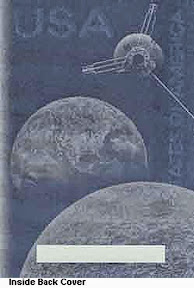
It's Pioneer 10, or maybe 11, mighty close to the Moon, with the Earth in the background[2]. I will leave it as an exercise for the student to prove that the point of view is about 450,000 kilometers from the Earth.

The Moon shows realistic detail, but, curiously, the Earth does not. There is not a cloud to be seen. Instead we see the outline of North America. It looks like a scene from a 1950s science fiction movie, before artists understood that the Earth really looks fairly fluffy and white when seen from space.

Also, the terminator appears to run from Kiribati in the Pacific to the Cape Verde Islands in the Atlantic. The subsolar point is near the northern Yukon. I haven't done the math, but this seems wrong for a planet inclined 23.5 degrees to its orbital plane.

Another surprise )

(By the way, here's an essay on the aesthetics of the new passport illustrations.)

[1] And I encourage other nations to do the same with their own space achievements.

[2] I doubt either Pioneer came quite this close to the Moon, but I have to allow the artists some license...
beamjockey: Drawing of Bill of the Heterodyne Boys by Phil Foglio. (Default)
After looking at a whole lot of paintings in a whole lot of MOMA's rooms, I sat down next to my brother on a bench in the middle of a gallery.

We sat there for a while, just resting. Looking at the walls. Watching the people going by.

"You know," my brother said, indicating his messenger bag, "I've got a Diet Coke in here.

"If you've got some Mentos, I can guarantee that we'll be in the New York Post tomorrow."
beamjockey: Drawing of Bill of the Heterodyne Boys by Phil Foglio. (Default)
Have you seen the story about the second-grader forbidden by security guards to sketch paintings in an art gallery-- because the paintings were copyrighted?

It brings to mind the 1830s painting "Gallery of the Louvre." This sinister practice has been going on a long time. This particular painting portrays dozens of paintings and sculptures, along with, yup, several young artists hanging around the gallery painting their own copies.


The artist is Samuel F.B. Morse, the troublemaker whose meddling eventually led to all this Internet and whatnot. The finished painting allowed American eyeballs to feast on the distant Louvre's pirated masterpieces. The Terra Foundation folks, who presently own the painting, inform us that the art teacher in the center of the painting is Morse himself, and that the guy in the corner is his buddy, two-fisted adventure novelist James Fenimore Cooper.

They also explain: "Gallery of the Louvre is Morse's 'gallery picture,' a form first popularized in the seventeenth century, and the only major such example in the history of American art. In a gallery picture the works depicted are clear and distinctive copies of real or imaginary works of art that are related to foreground figures. Morse completed his copies of Louvre masterworks in Paris and returned to New York with his unfinished canvas in the fall of 1832."

(It's nice to see that the North Carolina Museum of Art has now changed its draconian policy. )
beamjockey: Drawing of Bill of the Heterodyne Boys by Phil Foglio. (Default)
It's time to ask a question.

In painting "The Sermon of St. Stephen at Jerusalem," did Vittore Carpaccio place,

Carpaccio's Sermon of St. Stephen at Jerusalem


over on the left-hand bottom, Mister Bumpy in disguise?

Profile

beamjockey: Drawing of Bill of the Heterodyne Boys by Phil Foglio. (Default)
beamjockey

May 2024

S M T W T F S
   1234
56789 1011
12131415161718
19202122232425
262728293031 

Syndicate

RSS Atom

Most Popular Tags

Style Credit

Expand Cut Tags

No cut tags
Page generated Apr. 4th, 2026 07:30 pm
Powered by Dreamwidth Studios